
Alabama's Public Records Framework
Alabama's baseline public-records right comes from Ala. Code § 36-12-40, which gives every citizen the right to inspect and copy public writings unless another statute expressly provides otherwise. That right is broad in principle. In practice, courts and agencies apply layers of additional rules before deciding what to hand over. For court records specifically, two sets of rules narrow and shape § 36-12-40: the Alabama Rules of Court-Record Privacy and Confidentiality and Rule 33 of the Alabama Rules of Judicial Administration.
Rule 33 draws a clear line between paper and electronic access. The rule states the public's right to inspect and copy physical court records at circuit clerks' offices continues under § 36-12-40. At the same time, Rule 33 says access to electronic AOC databases including Alacourt, AlaFile, AlaPay, and AlaVault is through registered or subscription programs, and fees apply. That explains why you can walk into the Baldwin County Courthouse and inspect physical files but must pay a search fee to pull the same data through the online Alacourt system.
The Alabama Rules of Court-Record Privacy and Confidentiality cover every level of the court system: appellate, circuit, district, juvenile, small claims, municipal, and probate courts. Their stated goals are to maximize access and promote accountability while also protecting personal privacy and avoiding undue burden on courts. Rule 201 lists categories exempt from public access. Rule 301 sets procedures for sealing records. The framework also rests on Ala. Code § 36-12-41, which supports the practice of getting certified copies from record custodians.
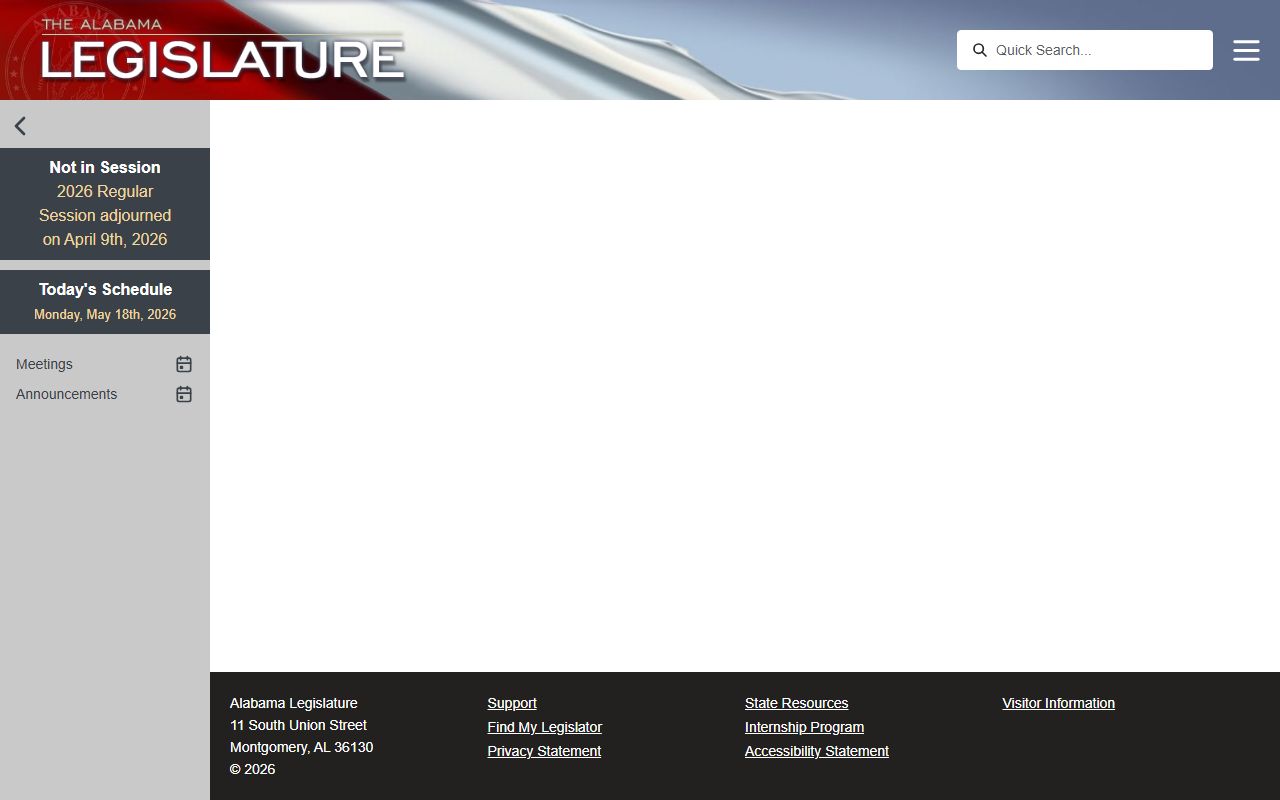
The screenshot below shows the official Alabama Code page for § 36-12-40 on the state legislature's ALISON system. The statute text on that page is the foundation for every public-records request filed in Baldwin County.
What Records the Baldwin County Circuit Clerk Holds
The Baldwin County Circuit Clerk, Brenda Ganey, is the official custodian of court files for the 28th Judicial Circuit. That means she holds records from Baldwin County Circuit Court and Baldwin County District Court only. The official request form says the office "has Baldwin County Circuit and District Court records only" and cannot provide federal records, municipal records, or records from other counties or states. If you need a court record, start here for any case that went through state trial court in Baldwin County.
The range of records held by the Circuit Clerk is wide. Civil cases include complaints, motions, orders, judgments, garnishments, subpoenas, and cost records. Criminal files include indictments, felony and misdemeanor charges, warrants, arraignment records, sentencing orders, probation terms, and restitution orders. Domestic relations files cover divorce complaints, decrees, settlement agreements, child-support documents, and custody orders. The clerk also holds small claims filings, traffic case records, and civil commitment appeals. For deeper detail on any of these record types, see Baldwin County court records or the Clerk of Court page.
The Circuit Clerk does not hold probate-court files, marriage certificates, real-estate recording documents, or business licenses. Those belong to a separate office. The clerk also serves as Absentee Election Manager and handles passport applications, but those are not court records. Keep this scope in mind before you file a request. Sending a circuit clerk form to the wrong office adds time and does not guarantee a response on the records you actually need.
- Circuit Court civil, criminal, and family-law cases
- District Court misdemeanor, traffic, juvenile concurrent, and small-claims cases
- Domestic relations filings including divorce decrees and child-support orders
- Felony indictments, sentencing orders, and probation files
- Small-claims judgments, garnishments, and writs of execution
What the Baldwin County Probate Office Holds
The Baldwin County Probate Office is a separate county office led by Judge of Probate Harry M. D'Olive, Jr. Its scope is broader than the name suggests. The Probate Court handles wills and estates, guardianships, conservatorships, adoptions, involuntary commitments, legitimation, name changes, and claims against estates. The Recording Division records, indexes, and preserves permanent public documents, which in practice means real-estate records, deeds, mortgages, UCC filings, and related instruments. The Probate Office also records marriage certificates, issues vehicle and boat licenses, and handles certain election functions.
For online probate case research, use the DuProcess iQuery search portal. It is free and open to the public. You can search by last name, first name, middle name, case type, or case number. Detail panes show case number, file date, case type, judge, status, related parties, dockets, events, payments, assessments, sentence, bonds, and warrants. This is the right tool for estate cases, guardianship files, name changes, and similar probate matters.
Marriage certificates recorded on or after August 29, 2019 are held at the Bay Minette Probate location only. Pre-2019 marriage licenses are also kept there. Certified copies of marriage records cost $3.00 each and must be requested using the Probate certified-copy form. The Probate Recording Division handles real-estate documents and related public records through Bay Minette and satellite offices in Fairhope, Foley, and Robertsdale. If you need probate court records, always start with the Probate Office rather than the Circuit Clerk.
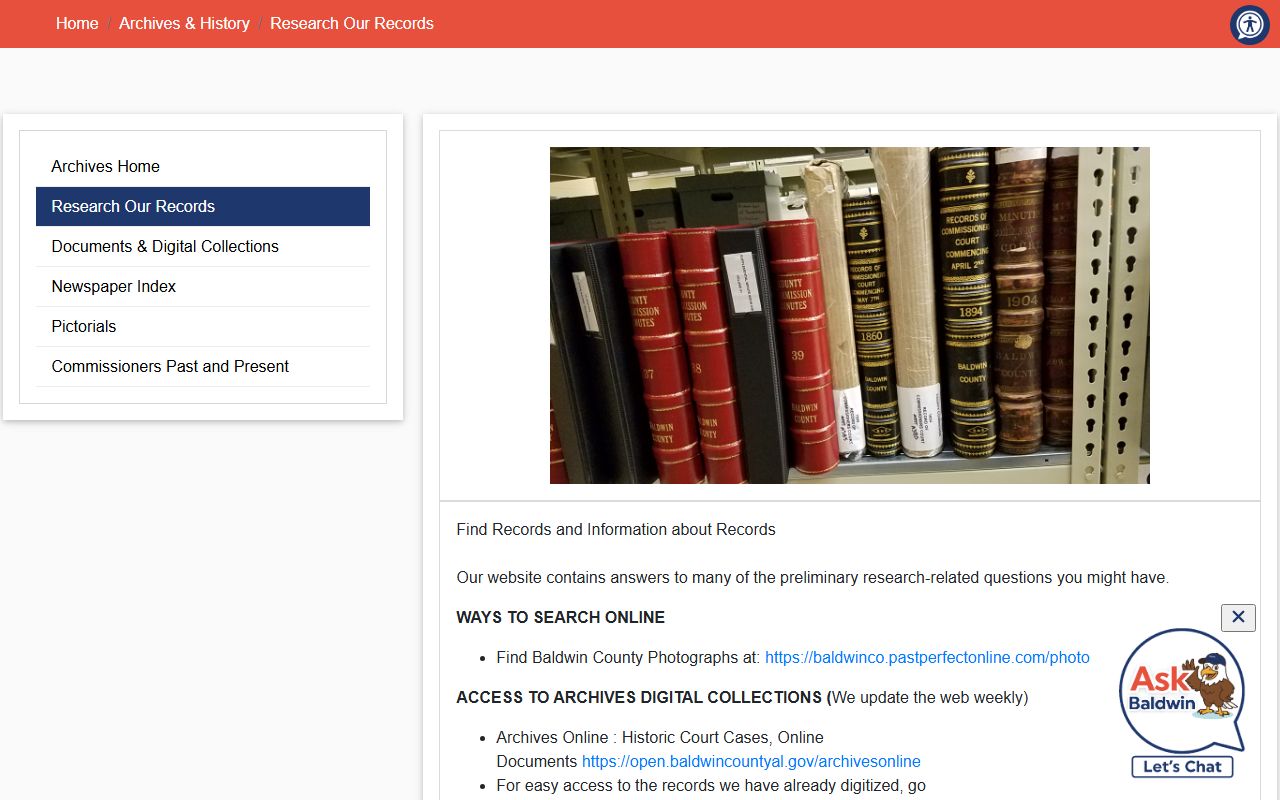
The screenshot below shows the Baldwin County Archives research page, which links to historic court records, digital collections, and the Probate Court collection guide covering materials from 1889 through 1944.
The Open Baldwin Public Records Portal
Baldwin County maintains a public-records landing page at open.baldwincountyal.gov. The portal is unusually broad for a county of this size. It links to records and data from many county offices in one place, making it a useful first stop before you decide which office to contact for a formal request.
The screenshot below shows the Open Baldwin portal home page, which lists public-access links for multiple county offices and databases.
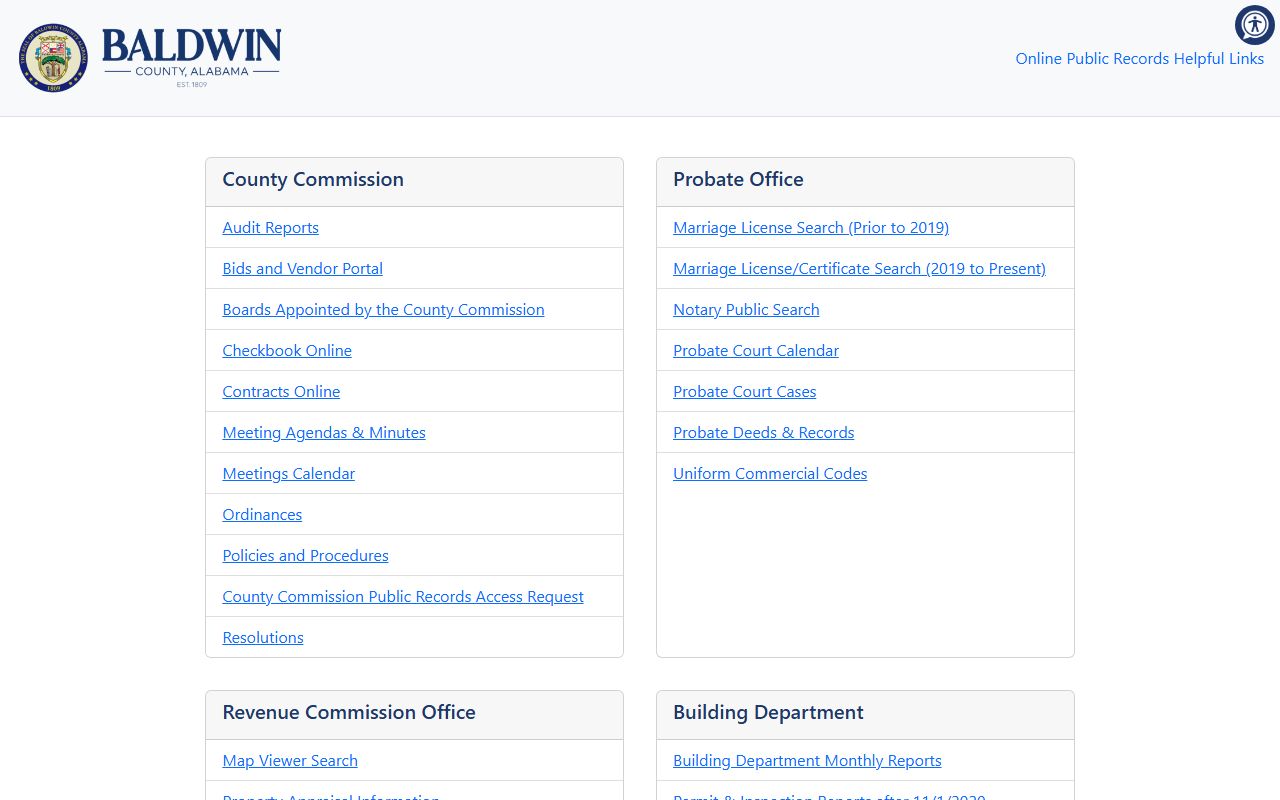
Open Baldwin links to a wide set of public records. The portal includes County Commission audit reports, bid and vendor documents, board agendas and minutes, checkbook data, contracts, ordinances, policies, formal public-records requests, Probate marriage search, Probate Court calendar, Probate Court cases, Probate deeds and recorded documents, UCC filings, Revenue property searches, building permits, Archives catalogs, historical circuit court cases, Sheriff sex offender registry, and inmate search. Most of these links route to the relevant official county or court system rather than a copy stored by a third party. For broad county-level data, the Open Baldwin portal is the right place to start.
Note: Open Baldwin links to official portals but does not itself hold the source records; always follow through to the specific office page to confirm the record you need and the access method available.
How to File a Baldwin County Public Records Request
For Circuit and District Court records, the Baldwin County Circuit Clerk has a formal request form. The form can be mailed or faxed to the courthouse in Bay Minette. There is no online submission for this specific form, and walk-in requests are handled at the clerk's counter during business hours. For other county records such as commission documents or non-court county data, the Open Baldwin portal routes to the county's general public-records request process. The steps below focus on the Circuit Clerk process because that is the most common records request involving court files.
- Identify the right office. Decide whether you need Circuit or District Court records (Circuit Clerk), probate or marriage records (Probate Office), or broader county records (Open Baldwin or the relevant county department). The Circuit Clerk cannot provide federal, municipal, or out-of-county records.
- Download or obtain the request form. The official Circuit Clerk record-search and copy request form is available on the 28th Judicial Circuit site at baldwin.alacourt.gov. Fill it out completely. Missing fields slow processing.
- Describe the records as specifically as possible. Include the case number if you have it, the full name of the party, date of birth or alias if known, the type of record you want (copies, certified copies, docket printout), and the time period involved. Vague requests take longer and may result in a broader search fee.
- Calculate and include the correct payment. Search fees apply even if no records are found. Use the official fee schedule to estimate your cost. The clerk does not accept personal checks. Pay by money order, cashier's check, or cash if visiting in person.
- Submit by mail or fax. Mail the completed form and payment to Baldwin County Circuit Clerk, 312 Courthouse Square, Suite 10, Bay Minette, AL 36507. The fax number is 251-937-0277. Keep a copy of everything you send.
- Allow two weeks for processing. The official request form says to allow two weeks. Complex or archived requests may take longer. Alacourt ACCESS is faster for online name or case-number searches if the record is available there and you do not need physical certification.
- Receive and review your records. The clerk will mail or email results based on what you selected on the form. If records are unavailable or the request falls outside the clerk's scope, you will be notified. There are no refunds on search fees.
Baldwin County Public Records Request Form Fields
The Circuit Clerk's official record-search and copy request form captures the information needed to run the search and return results. The table below lists every field on the form based on the official document. Fill out all fields that apply; incomplete forms delay processing. The form is used for both in-office and mail or fax requests.
| Field Label | Required | Notes |
|---|---|---|
| Date | Yes | Date you are submitting the request. |
| Specific Information Requested | Yes | Describe the records you want in detail. More specific requests run faster. |
| Case Number(s) if known | Optional | Providing the case number speeds the search and may reduce cost. |
| Identifying Information (e.g., DOB, alias) | Optional | Date of birth or alias helps distinguish parties with common names. |
| Is certification required? | Yes | Check Yes or No. Certification adds $5.00 per document. |
| Name | Yes | Your full legal name as the requester. |
| Address | Yes | Your mailing or street address. |
| City / State / Zip | Yes | Complete address for mailing results back to you. |
| Telephone Number(s) | Yes | Best number to reach you if the clerk has questions. |
| Optional | Required if you want results delivered by email rather than mail. | |
| Do you want records mailed or emailed? | Yes | Choose one. Electronic delivery may be faster for some record types. |
Baldwin County Public Records Fees
The Circuit Clerk's fee schedule applies to all record searches, copy requests, and certifications. Fees are set regardless of outcome. If a search finds no records, the search fee still applies and will not be refunded. This is stated directly on the official request form. Plan for the full fee before you submit.
| Item | Fee |
|---|---|
| Computerized records search | $10.00 |
| Paper, archived, or microfilmed records search | $25.00 |
| Copies, pages 1 through 20 (paper or electronic) | $5.00 total |
| Each additional page over 20 | $0.50 per page |
| Each certification | $5.00 |
Probate Office fees are separate and differ by record type. Certified copies of a marriage license or marriage certificate recorded in Baldwin County cost $3.00 each through the Probate Office. Recording a new marriage certificate costs $73.00, which includes one certified copy. Probate court filing fees vary by case type: adoption filings cost $96.00, guardianship filings cost $30.00, name changes cost $25.00, and probate of a will five pages or less costs $58.00. See the official Probate filing-fee page for the full list. For more on probate matters, visit the Baldwin County probate records page.
Note: The Circuit Clerk does not accept personal checks; pay by cash, money order, or cashier's check, and confirm the current payment methods before mailing a request.
Response Times for Baldwin County Public Records
The Circuit Clerk's official request form says plainly: "PLEASE ALLOW TWO WEEKS." That two-week window is the best planning estimate for mail and fax requests. It is not a statutory deadline tied to any specific penalty, but it is the clerk's own guidance, so treat it as the floor rather than a best case. Requests involving older archived or microfilmed records may take longer because staff must physically locate materials that are not in the computerized system.
If you need a faster result and the record is available online, use Alacourt ACCESS at pa.alacourt.com. Name searches and case-number searches return results on demand for $9.99 each. Document images cost $5.00 for the first 20 pages and $0.50 per page after that. Alacourt covers criminal records, civil records, small claims, state traffic, domestic relations, and child support. It does not replace the clerk's office for certified copies of older records, but it is much faster for active or recent cases.
Probate records through the DuProcess iQuery portal are free and return results immediately online. If you need certified copies of probate documents, contact the Probate Office directly. In-person requests at the Bay Minette location are accepted during business hours, 8:00 a.m. to 4:30 p.m. Monday through Friday. The Probate Office recommends avoiding the 11:00 a.m. to 1:30 p.m. window when wait times run longer, and it strongly encourages scheduling an appointment when possible.
Records That Are Exempt or Restricted in Baldwin County
Not every Baldwin County record is open to the public. Alabama law, court rules, and individual court orders create a defined set of categories that are exempt or restricted. These limits apply whether you request records in person, by mail, or through an online portal. Knowing the main restricted categories before you file saves time and avoids frustration.
Juvenile records are among the most firmly restricted. Ala. Code § 12-15-133 limits who can inspect juvenile court files. Access is generally available only to parties, attorneys, specified agencies, prosecutors, courts, or individuals authorized by the juvenile court after showing legitimate need. Public databases do not display juvenile cases the same way they show adult criminal cases. If you submit a public-records request and the file turns out to be juvenile, the clerk will tell you access is restricted rather than hand over the file.
Expunged records are another key category. Under Ala. Code Title 15, Chapter 27, once a court grants an expungement, covered official records are handled according to the statute. For practical purposes, the public record should no longer appear as an ordinary searchable entry. Section 15-27-6 describes the effect of an expungement order and the narrow circumstances under which expunged records may still be inspected. An expungement order affects official court, sheriff, and ALEA records but does not automatically remove private websites, news archives, or out-of-state systems.
Other restricted categories in Baldwin County include: adoption files (confidential under Alabama law and probate rule); involuntary mental-health commitment records (medical and psychiatric information is protected); sealed court records (sealed by court order under the privacy rules and Holland v. Eads standards); grand jury materials and pending criminal investigation records; personal identifiers such as Social Security numbers, financial account numbers, minor children's names, and medical data (redacted under court privacy rules); and attorney work product or privileged communications even when a case exists in the public record. For criminal records that may have restricted elements, always check whether expungement or sealing has occurred before relying on search results.
- Juvenile court files (restricted under Ala. Code § 12-15-133)
- Expunged criminal records (restricted under Ala. Code Title 15, Chapter 27)
- Sealed court records (sealed by court order under Alabama court privacy rules)
- Adoption records (confidential; not general public access)
- Involuntary mental-health commitment records
- Grand jury materials and open criminal investigations
- Personal identifiers: SSNs, financial accounts, minor names, medical data
Baldwin County Archives and Historic Records
For records older than the live digital systems, the Baldwin County Archives is the right contact. The Archives is located at 305 East 2nd Street, Bay Minette, AL 36507, and can be reached at (251) 580-1897. Its mission is to preserve, acquire, and make accessible the documented heritage of Baldwin County for researchers, genealogists, historians, journalists, and the general public.
The Archives holds a preserved collection of Probate Court materials from 1889 through 1944. This collection includes miscellaneous fee books, land-court assessments, Probate Court index books, and related documents. The official Archives guide to that collection states there are no access restrictions on it, though researchers bear responsibility for copyright issues involving materials not yet in the public domain. Historic circuit court case records and digital collections are also available through the Archives research page, which links to online archives, a PastPerfect database, a newspaper index, photo collections, and an Archives catalog.
If you need a court record from before the computerized era and the Circuit Clerk's office cannot locate it in paper or microfilm, the Archives may have transferred materials or finding aids that point to the right source. Historic probate and courthouse records that predate the county's digital systems are generally only accessible through Archives research, not through Alacourt or DuProcess.
If Your Baldwin County Records Request Is Denied
A denial or incomplete response to a public-records request in Baldwin County is not necessarily the final word. The right steps depend on which office held the record and the reason given for the denial. Some denials are based on a specific exemption and are correct under the law. Others may involve a misunderstanding about what records exist, where they are filed, or whether a restriction applies. Before escalating, re-read the denial notice carefully to understand the stated reason.
For court records held by the Circuit Clerk, the starting point for challenging a denial is identifying whether the record is truly exempt under the Alabama Rules of Court-Record Privacy and Confidentiality or a specific statute. If the denial cites an exemption you believe does not apply, you may write back to the clerk's office with a specific legal argument. For records that are sealed by court order, you would need to file a petition with the court that issued the sealing order to seek access. That process is governed by the court privacy rules and Alabama Supreme Court precedent.
If you believe a public agency has wrongly withheld non-exempt records, Alabama law does not create a single administrative appeal route with a strict deadline the way some states do. Options include contacting the Alabama Attorney General's office, seeking an informal review from the relevant agency supervisor, or pursuing a civil action in circuit court. For Baldwin County Circuit and District Court records specifically, a formal motion to the presiding court can be a route to compel access to specific court files. Getting legal advice before escalating is a sound step, especially if the stakes are significant. The Alabama State Bar Lawyer Referral Service and Legal Services Alabama serve the Baldwin County area for those who qualify for civil legal aid.
For county-level records held by the Commission, Probate, or other departments, the Open Baldwin portal lists the formal public-records request route. If that request is denied and you believe the denial is improper, the same general escalation logic applies: document the request, review the denial reason, seek clarification, and consider legal counsel if the matter is important enough to pursue further.