
Baldwin County Jail Capacity Overview
The Baldwin County Sheriff's Corrections Center at 200 Hand Avenue, Bay Minette holds adults in pretrial and sentenced custody. County procurement documents describe it as a 654-bed facility. A separate 30-bed Juvenile Detention Center also operates in the Bay Minette area but is administered under a different program and is not mixed with the adult population. Together the two facilities represent the county's full detention footprint under Sheriff Anthony E. Lowery.
The 654-bed figure comes from the official county medical services RFP, which used that number as the baseline for contract planning. The Corrections Command page does not restate the bed count in those exact terms, but it does confirm an average daily population (ADP) of approximately 550, with periods that exceed that number. The difference between the official ADP and the rated bed count is not a sign of empty beds; rather, it reflects how population fluctuates from day to day based on bookings, releases, transfers, court orders, and hold agreements with other agencies.
The Corrections Center houses inmates from several jurisdictions. That means the 654 beds serve not only Baldwin County residents but also people transferred under agreements with municipalities, federal agencies, and state corrections. Capacity planning at this facility has to account for all of those populations at once.
| Facility | Beds | Notes |
|---|---|---|
| Baldwin County Sheriff's Corrections Center | 654 | Adult facility; 200 Hand Ave, Bay Minette; bed count per official county RFP |
| Baldwin County Regional Juvenile Detention Center | 30 | Bay Minette area; separate juvenile program; bed count per official medical RFP |
Average Daily Population in Baldwin County
The Sheriff's Corrections Command page puts the ADP at approximately 550, but notes that the number is exceeded at times. A separate 2025 inmate-technology procurement document gives a wider operating range, stating the center currently houses an average of 550 to 700 adult inmates per day. These two figures are not in conflict: the Corrections Command ADP represents the ongoing baseline, while the RFP range captures the full swing including peak periods.
One way to see what 1,740 means in practice: the Corrections Command page states the food service team prepares an average of 1,740 meals per day. That figure is driven directly by the number of people in custody on any given day plus any special-diet counts. It is a useful cross-check on population scale even though it is not a formal population census. At roughly three meals per person per day, a 1,740 meal count implies a housed population in the range of 580 at the time that average was established.
A forward-looking figure also appears in county records: the official medical services RFP projected an ADP of 1,038 over the following three years. That number is a procurement projection used for contract sizing, not a current census or an observation from any specific day. It reflects expected population growth pressure, the facility expansion that was underway, and the contractor's need to plan staffing and supply capacity. Present it as a projection, and note that Baldwin County is one of Alabama's fastest-growing counties, which adds residential growth to the pretrial and hold populations that fill jails.
| Metric | Number | Source |
|---|---|---|
| Adult Corrections Center rated capacity | 654 beds | Official county RFP |
| Average daily population (ADP) | Approximately 550 | Sheriff's Corrections Command page |
| Daily population operating range | 550-700 | Official inmate-technology RFP (2025) |
| Projected ADP (contract planning figure) | 1,038 over next three years | Official medical RFP projection; not a current census |
| Annual intake average | 15,000+ | Sheriff's Corrections Command page |
| Meals prepared per day | 1,740 | Sheriff's Corrections Command page |
| Juvenile Detention Center capacity | 30 beds | Official medical RFP; separate juvenile program |
Note: ADP, rated capacity, operating range, and projected ADP are four different metrics; each figure below is labeled with its source so readers can tell them apart.
Pretrial vs. Sentenced Baldwin County Inmates
The Sheriff's Corrections Command page states that a majority of inmates are pretrial detainees awaiting court action. No percentage is published in the official sources reviewed, so no exact number is assigned to that split. The qualitative statement still tells an important story: most people held at the Corrections Center on any given day have not been convicted. They are there because of bond status, a no-bond order, a warrant hold, or court scheduling, not because a judge or jury found them guilty.
Pretrial detention in Baldwin County can arise from several paths. A person arrested on a new charge may be held if bond is set beyond what they can pay, or if the court denies bond for serious charges. A person may be held on a bench warrant for missing a court date. Federal or ICE holds can keep a person in local custody regardless of local bond eligibility. Municipal holds under local agreement also add to the pretrial count without reflecting a new Baldwin County criminal charge. All of these categories land in the same facility and contribute to the daily population figure.
Sentenced inmates at the facility are those who received a conviction and are serving a county sentence or awaiting transfer to the Alabama Department of Corrections for a state prison term. Work-release inmates are another category: they may leave the facility for jobs and return each night, but they still count toward the housed population. Understanding these categories helps explain why the jail population does not simply track arrests one-for-one.
For live information on a specific individual, use the Baldwin County inmate records search through the official Citizen Connect portal. Bond amounts and charges are available from the Corrections Docket Room at (251) 937-0202.
Annual Intake and Booking Volume
The Corrections Command page says the intake process averages more than 15,000 people per year. That figure represents total bookings, not a headcount of unique individuals, because some people are booked more than once in a calendar year. An intake of 15,000 in a facility with an ADP of roughly 550 implies significant churn: people move in and out fairly quickly on average, though some individuals stay for extended periods while awaiting trial on serious charges.
The Intake Division handles booking, release, the Docket Room, inmate classification, inmate transportation, and liaison to courts, judges, and the District Attorney's Office. When someone is booked, Docket Room staff screen them with a medical questionnaire and refer to the Medical Service Unit unless pre-booking population prevents immediate assessment. Classification determines housing and program placement. The Intake Division also keeps inmates updated on court cases when information is available, though families with detailed questions are directed to the inmate's attorney.
The sheer volume of 15,000 annual intakes means the booking system operates at roughly 40 or more admissions per day on average. The official Corrections Command page says the center provides 24-hour booking information online. That data feeds directly into the Citizen Connect system, which is why the portal's "Admits by Date Range" and "Last 24 Hours" search tabs can show fresh booking data at any time of day.
Federal, ICE, Work Release, and Municipal Holds
The official medical RFP describes the Corrections Center as housing several distinct inmate categories: pretrial inmates, federal inmates including Homeland Security during transit, convicted county inmates, and work-release inmates. The facility also holds inmates under an agreement with at least one local municipality except for safekeeping holds. Each category affects the population count differently and has different legal status, release triggers, and funding arrangements.
Federal and ICE holds are particularly relevant to understanding why the jail population can rise above what local arrest activity alone would suggest. A person detained by U.S. Immigration and Customs Enforcement (ICE) or held as a federal pretrial detainee under a U.S. Marshals agreement stays at the county facility but is not a Baldwin County case in any criminal-justice sense. Looking at the Citizen Connect arresting agency dropdown confirms the range: it lists U.S. Immigration and Customs Enforcement (ICE) and U.S. Marshals as possible arresting agencies, alongside Baldwin Co SO, Bay Minette PD, Daphne Police, Fairhope Police, Foley Police, Gulf Shores PD, Orange Beach PD, and others.
Work-release inmates occupy a middle position. They have been sentenced, they leave for employment during the day, and they return each night. They count toward the housed population when present but represent a lower-security classification than pretrial detainees or sentenced inmates serving their full sentence on-site. The Sheriff's Community Corrections program provides a related alternative: it supervises eligible offenders in the community rather than the jail, which helps preserve bed space for higher-risk cases. See the Community Corrections page for program details.
Note: Municipal holds and federal transit holds count toward the daily population total, which is why the ADP does not reflect only Baldwin County criminal cases.
Medical and Observation Capacity at the Corrections Center
The official medical RFP notes that three observation rooms are included in the total 654-bed count. These rooms serve people who need medical monitoring, mental health observation, or protective housing rather than general population placement. Because they are counted within the 654-bed figure, the effective general-population capacity is slightly lower when observation rooms are in use.
Intake includes a medical post where staff assess arrestees on arrival. Docket Room staff apply a medical questionnaire at booking and refer individuals to the Medical Service Unit when a health concern is flagged. The only exception is when pre-booking volume prevents an immediate assessment; in that case, medical follow-up occurs as soon as practical. This intake screening process is a standard part of jail operations and helps identify acute medical needs before general classification and housing.
Inside the Corrections Center, the Medical Service Unit provides full-service medical and dental care through a locally contracted doctor and dentist. Sick calls run daily. Inmates are seen in order of medical need after examination, and care is provided without regard to ability to pay. If an inmate has funds in a trust account, a co-pay may be charged. The food service team prepares meals that comply with dietitian recommendations and meet religious or medical diet requirements. The 1,740 average daily meal count includes all special-diet trays in addition to the standard count.
Juvenile Detention Center Capacity in Baldwin County
The Baldwin County Regional Juvenile Detention Center is a separate facility from the adult Corrections Center. The official medical RFP identifies it as a 30-bed facility in the Bay Minette area. Juvenile detainees are not housed with the adult population, and the 30-bed JDC count is separate from the 654-bed adult figure. The two facilities operate under different legal frameworks because juvenile records and juvenile custody are governed by distinct rules under Alabama law.
Alabama Code Section 12-15-133 restricts access to juvenile court records. The same general confidentiality philosophy applies to juvenile detention information: the public record of who is held in juvenile detention is not published in the same way adult booking data is posted through Citizen Connect. Families with questions about a juvenile in detention should contact the Sheriff's Office or the court handling the juvenile case directly.
For purposes of understanding the Baldwin County inmate population, the practical point is simple. When you see ADP figures of approximately 550 or a bed count of 654, those numbers describe adults only. The JDC's 30 beds are an entirely separate operational unit and should not be added to the adult figures when describing jail capacity.
Baldwin County Corrections Center Expansion History
The Sheriff's history page states the Corrections Center, formerly known as the County Jail, has served Baldwin County for over 200 years. The facility as a physical structure is much newer: county procurement documents say the original adult Corrections Center was built in 1964. Expansions followed in 1985, 1992, and 1996 as the county's population and detention needs grew. A major new expansion cycle then began around 2020.
Sheriff Anthony E. Lowery served as project manager for a $70 million Corrections Center expansion that began in 2020. That project was successfully completed and officially opened in early 2026. The expansion added significant capacity above the pre-expansion footprint, which is why the official medical RFP could project an ADP of 1,038 over the next three years: the new beds and facilities created room for population growth that was not available before. The 654-bed figure in the RFP likely reflects the facility as it was being planned during procurement rather than the final post-expansion count, but it is the most precise official number available in reviewed sources.
Baldwin County's growth context matters here. The county has been among Alabama's fastest-growing for more than two decades, driven by Gulf Coast development, eastern shore residential expansion, and tourism-related economic activity. Jail capacity tends to follow population growth with a lag because facility construction takes years. The 1985, 1992, and 1996 expansions were responses to earlier growth cycles. The $70 million expansion opened in early 2026 is the most recent response to sustained growth pressure and a pretrial population that consistently tests the older building's capacity.
The screenshot below is from the official Baldwin County Corrections Command page, which is the primary public source for ADP, accreditation status, intake volume, meal count, and facility program descriptions.
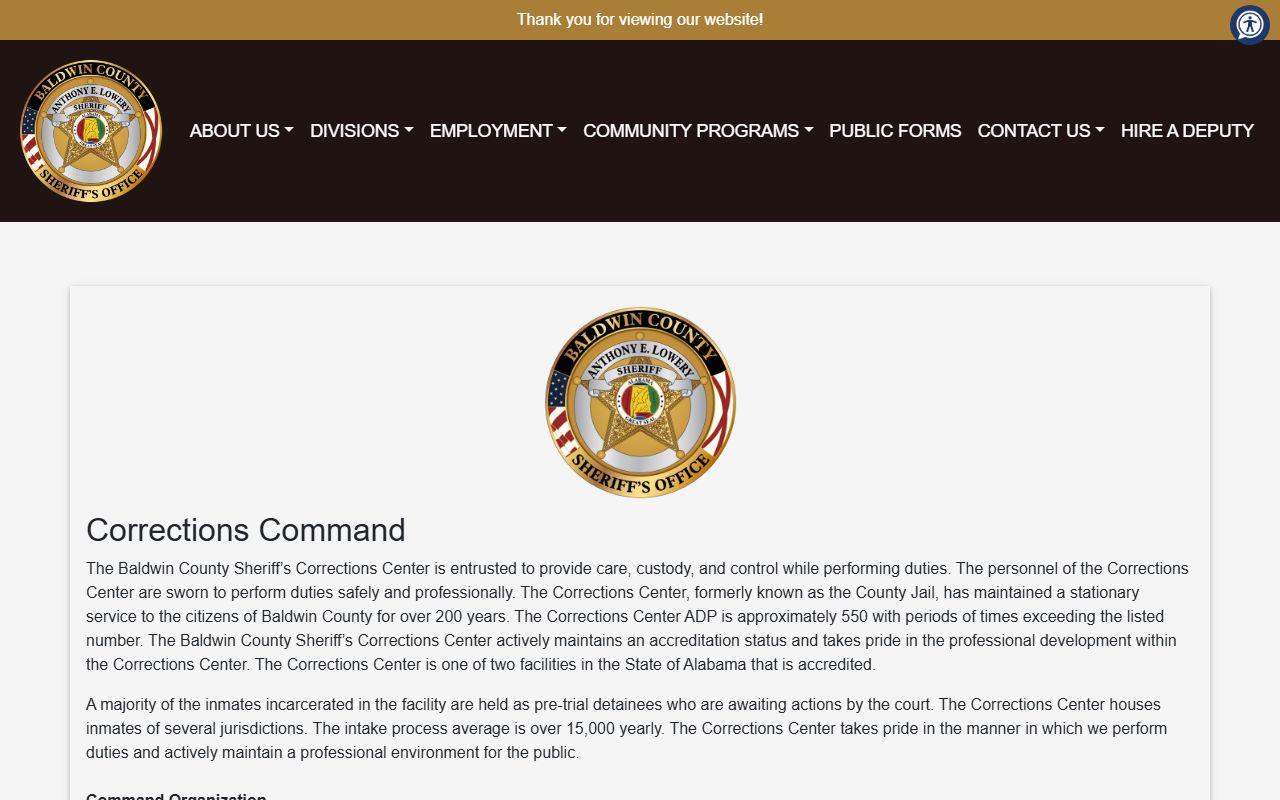
The Corrections Command page states the center actively maintains accreditation and is one of two facilities in Alabama that holds accredited status. That accreditation record is consistent with a facility that has invested heavily in professional standards over decades of expansion.
The image below is from the official Sheriff's history page, which describes the $70 million expansion and Sheriff Lowery's role as project manager for that project.
That history is relevant to anyone researching Baldwin County inmate population trends: the numbers you find in older procurement documents, annual reports, or third-party data sets may describe a different physical facility from the one that opened in early 2026.
State and National Jail Population Context
No official per-100,000 detention rate for Baldwin County is published in the sources reviewed, so no such figure is invented here. What can be said is that the Bureau of Justice Statistics (BJS) and the BJS data portal publish annual national jail surveys that include state-level and county-level data where jurisdictions report. The Vera Institute of Justice tracks county jail trends over time, including pretrial detention rates and length-of-stay patterns by state and county.
Note: No per-100,000 Baldwin County jail rate is published in official county sources; use BJS county-level data tables to compute a local rate if needed for research purposes.
The table below shows what is measured at each level. It frames the comparison honestly without substituting estimated or invented numbers for missing local data.
| Level | What Is Measured | Where to Find It |
|---|---|---|
| Baldwin County | ADP approximately 550 at the 654-bed Corrections Center; annual intake 15,000+ | Sheriff's Corrections Command page; county RFPs |
| Alabama | Jail rates per 100,000 tracked in BJS Annual Survey of Jails; state totals vary by reporting cycle | BJS.ojp.gov jail data tables |
| National | National jail incarceration rate per 100,000 tracked annually by BJS; Vera Institute tracks county pretrial trends | BJS Annual Survey of Jails; Vera Institute Incarceration Trends |
Baldwin County's pretrial-majority population is consistent with national patterns. The BJS has consistently found that a majority of people held in local jails nationwide are awaiting trial rather than serving a sentence. The Vera Institute's county trend data shows that pretrial detention grew faster than sentenced detention in most counties over the past two decades, driven by unchanged bail practices and rising felony charge rates. Baldwin County fits that broader picture, though county-specific trend data would require accessing BJS's individual county data sets.
The screenshot below is from the Bureau of Justice Statistics website, the primary federal source for national and state-level jail population data and the starting point for any per-100,000 rate comparison involving Baldwin County.
For Baldwin County's specific census-based population to compute a per-100,000 rate, use the most recent U.S. Census Bureau estimate alongside the ADP figure from the Corrections Command page. The result is a rough local rate. Keep in mind it excludes federal and ICE holds if your goal is to measure local criminal justice detention only.
Where the Inmate Population Data Comes From
The primary public source for Baldwin County jail population data is the Sheriff's Corrections Command page. That page gives the ADP of approximately 550, the note about periods exceeding that figure, the majority-pretrial statement, the 15,000-plus annual intake, and the 1,740 daily meal count. It also confirms accreditation status and describes the command structure and major divisions.
Procurement documents are a secondary source. County RFPs for inmate technology services and medical services are public documents and include capacity figures, projected ADP, and facility descriptions that are more precise than the public web pages. The 654-bed count and the 550-700 daily range come from a 2025 inmate-technology RFP. The medical RFP adds the projected ADP of 1,038 and the three-observation-room detail. These documents are not always easy to find because they are issued through county procurement channels rather than the Sheriff's website.
The Sheriff's history page and bio pages for Sheriff Lowery add the $70 million expansion timeline, the 2020 start date, and the early-2026 opening. Those details are important for anyone trying to understand why capacity numbers shifted between older and newer sources. A document from 2022 describes a different facility from one written in 2026.
For live roster data, the Citizen Connect inmate portal is the official public-facing system. It shows current confinements, admits by date range, and releases by date range. The Corrections Center posts a disclaimer that the data is provided for convenience and cannot be certified for accuracy. For verified information on a specific person, call the Docket Room at (251) 937-0202 for bond amounts and charges.
National context data comes from the Bureau of Justice Statistics annual jail surveys and the Vera Institute's Incarceration Trends project. Neither source publishes real-time county data; annual survey data typically lags by one to two years. Always note the reference year when citing BJS or Vera data alongside current Baldwin County figures.
- Sheriff's Corrections Command
- ADP, intake, meals, pretrial majority, accreditation
- County RFPs (2025)
- 654-bed capacity, 550-700 daily range, 1,038 projected ADP, observation rooms
- Sheriff history / bio pages
- $70M expansion, 1964 original, 1985/1992/1996 expansions, early 2026 opening
- Citizen Connect portal
- Live roster, admits, releases, booking profiles
- Bureau of Justice Statistics
- State and national jail rates, annual surveys