
Baldwin County District Court Overview
Alabama's District Court is a court of limited jurisdiction. In plain terms, it handles the everyday docket: misdemeanor charges, traffic violations, small civil disputes, juvenile matters (concurrently with Circuit Court), and the early stages of felony cases. The Baldwin County District Court sits within the Twenty-Eighth Judicial Circuit and shares the same courthouse system as the Circuit Court, but the two courts are legally distinct with different authority. District Court can hear civil cases up to $20,000, including a small claims division capped at $6,000. It does not hold jury trials for most matters; defendants who want a jury trial on a misdemeanor must appeal to Circuit Court after a District Court conviction.
Felony cases start in District Court but do not end there. When someone is charged with a felony in Baldwin County, the District Court holds the preliminary hearing to decide if there is probable cause to send the case up to Circuit Court. If the charge is a non-death felony and the defendant wants to plead guilty, the District Court can accept that plea and dispose of the case without sending it to a grand jury. But felony trials take place in Circuit Court. That division of labor keeps the District Court focused on volume matters while Circuit Court manages the heavier trial calendar. For more detail on that process, see Baldwin County court records and the court dockets page.
Juvenile jurisdiction is shared. Both District and Circuit Court judges can hear juvenile matters in Baldwin County, though cases involving termination of parental rights and certain serious juvenile offenses typically go to Circuit Court. Juvenile records are confidential by law and do not show up in standard public searches on Alacourt or at the clerk's counter.
The Baldwin County District Court Judges
Baldwin County has two District Court judges appointed through Alabama's statewide judicial system. The presiding district judge is Hon. William E. Scully Jr. The second district judge is Hon. Michael J. Hoyt. Both judges cover the full range of District Court matters: criminal arraignments and trials, traffic dockets, civil hearings, small claims sessions, and juvenile proceedings. Neither judge is assigned exclusively to one case type or one building; the docket is managed across the Bay Minette main courthouse and the Fairhope and Foley satellite locations.
Alabama does not use a numbered "court at law" system like some other states. There is no "Baldwin County Court at Law No. 1" or "No. 2." Instead, the two district judges share one court, and cases are assigned as needed. This matters because people looking for a specific court number on their citation or notice will not find one; they should follow the location and time instructions on the document they received. For questions about a specific hearing date, contact the Circuit Clerk at (251) 937-0280 or check Alacourt ACCESS for case status.
Baldwin County Courts at a Glance
The table below covers the state trial courts that serve Baldwin County residents, including the Circuit Court, District Court, small claims, Probate Court, and municipal courts. The Circuit Clerk, Brenda Ganey, maintains records for the Circuit and District courts. Probate is a separate office under Judge Harry M. D'Olive, Jr. Municipal courts operate at the city level and are not part of the Circuit Clerk's record system.
| Court | Judges | Address | Phone | Jurisdiction |
|---|---|---|---|---|
| Circuit Court, 28th Judicial Circuit | Hon. J. Clark Stankoski (Presiding); Hon. Byron Brackin; Hon. Laurie A. Hoyt; Hon. Karol J. Kemp; Hon. Ashley Siebert; Hon. Scott P. Taylor | 312 Courthouse Square, Suite 10, Bay Minette, AL 36507 | (251) 937-0280 | Felony trials; civil over $20,000; family court; appeals from District, Probate, and Municipal courts |
| District Court | Hon. William E. Scully Jr. (Presiding); Hon. Michael J. Hoyt | 312 Courthouse Square, Bay Minette, AL 36507; satellites in Fairhope and Foley | (251) 937-0280; Fairhope: (251) 928-3002; Foley: (251) 943-5061 | Misdemeanors; preliminary felony hearings; non-death felony guilty pleas; civil up to $20,000; juvenile concurrent |
| Small Claims Division of District Court | District Court judges (same bench) | Bay Minette main courthouse; Fairhope and Foley satellites for trials | (251) 937-0280 | Civil disputes up to $6,000; informal process; no juries |
| Probate Court | Hon. Harry M. D'Olive, Jr. | 220 Courthouse Square, Bay Minette, AL 36507 (mailing: PO Box 459) | 251-937-0260; 251-990-4645; 251-970-4098; 251-972-6845 | Estates; wills; guardianship; conservatorship; adoptions; name changes; involuntary commitment; marriage certificate recording |
| Municipal Courts | Municipal judges (vary by city) | City-specific; not administered by Circuit Clerk | Contact individual city | City ordinance violations; municipal traffic and criminal matters; appeals go to Circuit Court |
The Circuit Clerk's official record request form notes the office handles Baldwin County Circuit and District Court records only. It cannot supply federal, municipal, or out-of-county records. For federal matters, see the U.S. District Court for the Southern District of Alabama in Mobile.
Baldwin County District Court Jurisdiction
The screenshot below is from the official District Court page on the Twenty-Eighth Judicial Circuit website, showing the court's jurisdiction summary and judge listings.
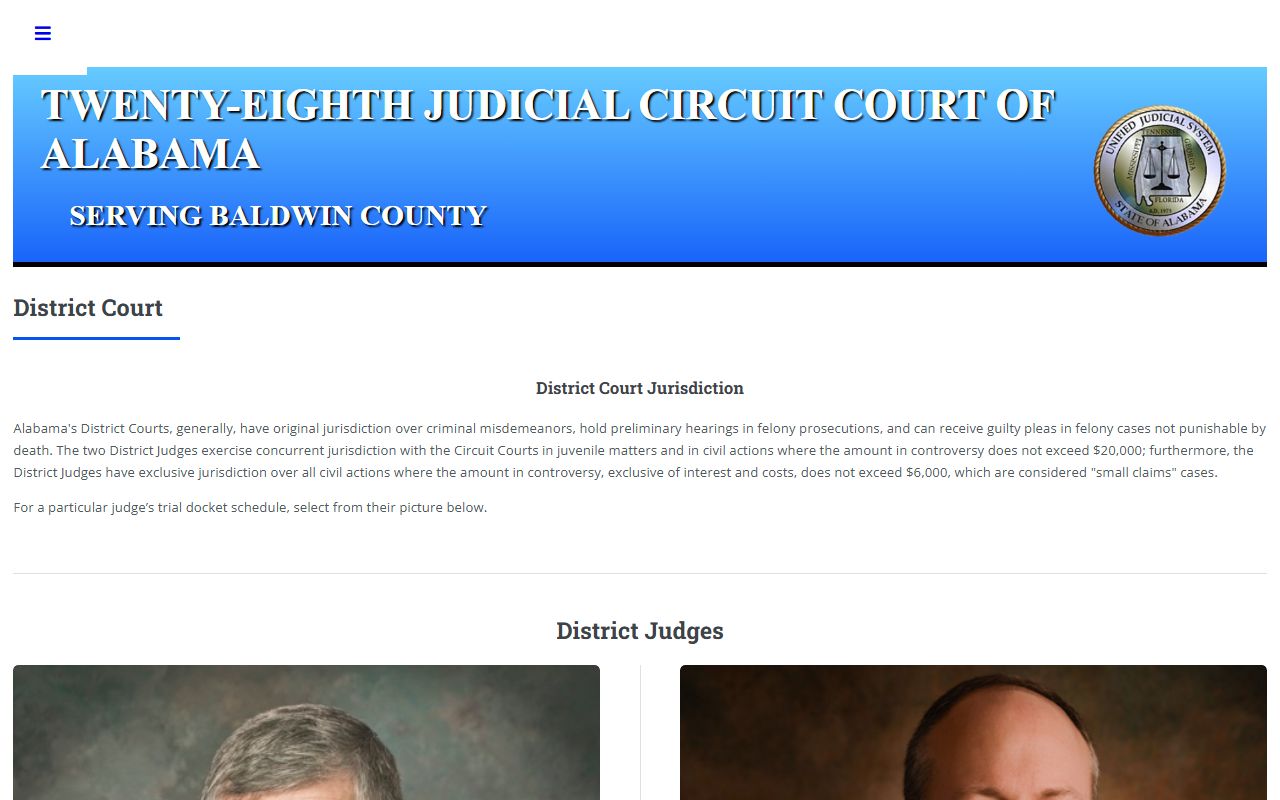
The page confirms Baldwin County District Court's authority over misdemeanors, preliminary felony matters, small claims, traffic, and civil cases up to the statutory threshold.
District Court jurisdiction in Alabama divides into four main categories. First, criminal: the court has full trial authority over Class A, B, and C misdemeanors. That covers most DUI charges, petty theft, simple assault, public intoxication, minor drug possession, and a wide range of ordinance-related offenses. Second, preliminary felony: when someone is arrested on a felony charge, the District Court judge holds the initial appearance and a preliminary hearing to decide if probable cause supports sending the case to a grand jury or Circuit Court. For non-death felony charges where the defendant agrees to plead guilty, the District Court can accept that plea and impose sentence without a grand jury indictment. Third, civil: the court can decide civil cases where the amount in dispute is $20,000 or less. That covers most landlord-tenant disputes, small contract claims, property-damage suits, and similar everyday conflicts. Fourth, small claims: a separate informal division for disputes up to $6,000, designed to let people resolve claims without a lawyer or complicated procedure.
Traffic cases are technically part of the criminal and civil docket but get their own process because of volume. Baldwin County District Court handles citations issued by Alabama State Troopers and county sheriff's deputies. Cases that go unresolved have real consequences: a warrant can issue, the driver's license can be suspended by ALEA, and any bond can be forfeited. See the Traffic Court section below for payment and appearance details. For access to criminal records flowing from District Court cases, visit the criminal records page.
Small Claims in Baldwin County District Court
The image below is captured from the official Baldwin County small claims page, which outlines filing steps, fees, and the answer deadline.
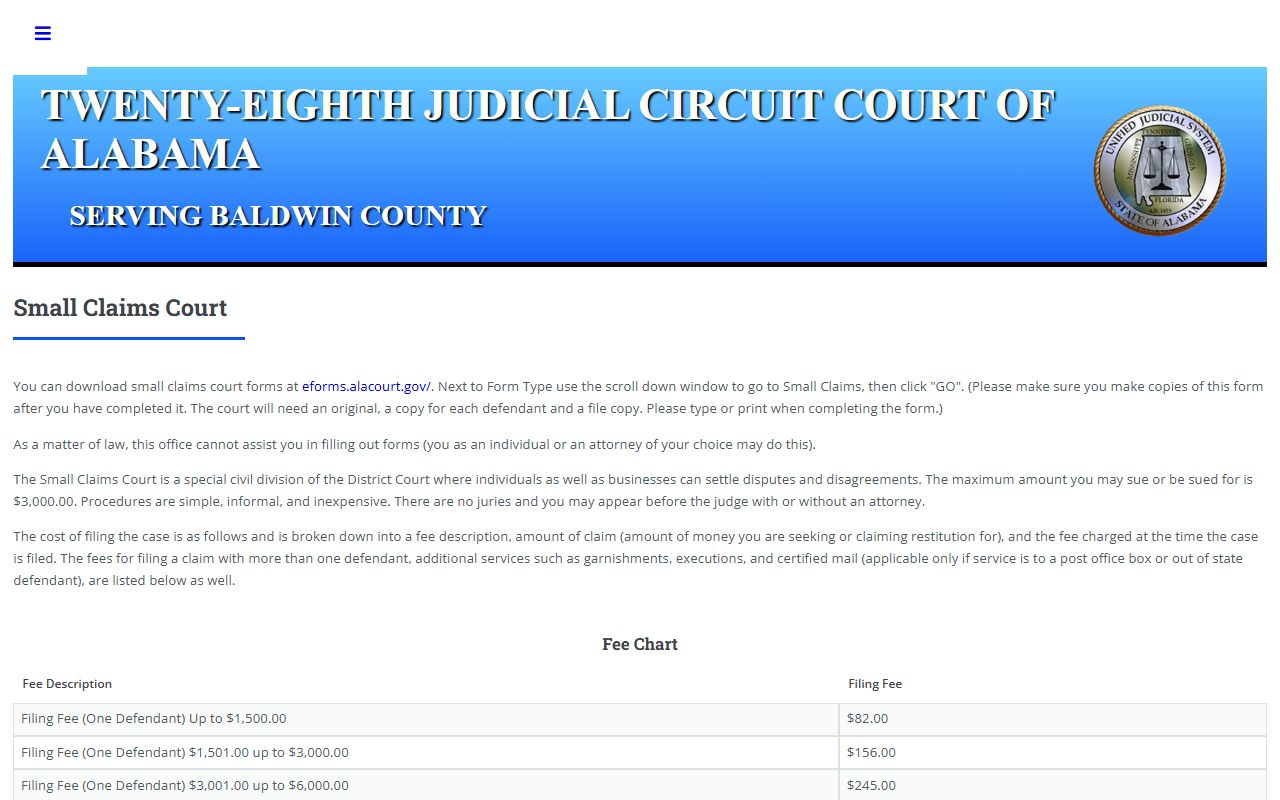
The official page walks filers through the Statement of Claim form, fee brackets, and what to expect on the hearing date.
Small claims is the most accessible part of Baldwin County District Court. Individuals and businesses can sue to recover money, property, or goods up to $6,000 without needing a lawyer. The process is intentionally informal: no formal rules of evidence apply, and the judge runs the hearing in a straightforward way. That said, the clerk's staff cannot help you fill out forms or give legal advice. If you are not sure your claim qualifies or how to document it, consider speaking with an attorney before filing.
To start a small claims case, file a Statement of Claim in the county where the defendant lives or has a place of business. Use the forms available through the Alabama eForms portal. The filing fee depends on how much you are claiming: $82 for amounts up to $1,500; $156 for $1,501 to $3,000; and $245 for $3,001 to $6,000. Each additional defendant costs $10. Once the clerk serves the defendant, that person has 14 days to file a written answer. If no answer is filed, you can ask the court for a default judgment.
Trial locations vary. Small claims cases can be heard at the Bay Minette main courthouse or at the Fairhope or Foley satellite courthouses. Check your notice for the specific location. After a judgment is entered, either side has 14 days to appeal by filing a Notice of Appeal with the small claims clerk. The appeal goes to Circuit Court. There are separate appeal filing fees, and the appealing party may need to post bond for unpaid costs. The official small claims FAQ covers appeal costs and the garnishment/execution process for collecting a judgment after you win.
Note: The clerk cannot help complete forms or provide legal advice; if you need help, use the Alabama State Bar referral service or Legal Services Alabama for guidance before your court date.
Misdemeanors and Preliminary Felony Hearings in Baldwin County
Most criminal cases in Baldwin County start in District Court. A misdemeanor charge goes from arrest to arraignment to trial in District Court, all without a jury unless the defendant is convicted and appeals to Circuit Court to get one. Common misdemeanor categories include DUI, simple assault, criminal mischief, minor in possession, driving with a suspended license, and petty theft. Alabama classifies misdemeanors as Class A (up to 1 year), Class B (up to 6 months), and Class C (up to 3 months), and the District Court judge can impose fines, jail time, probation, or a combination based on the charge and circumstances.
For felony charges, District Court is the entry point but not the finish line. At the first appearance, the judge advises the defendant of the charges, sets or reviews bond, and schedules a preliminary hearing. At that hearing, the judge decides whether the State has probable cause to move the case forward. If probable cause exists, the case goes to Circuit Court for grand jury presentation or trial. One important exception: if the offense is a non-death felony and the defendant wants to plead guilty, the District Court can accept the plea and sentence without sending anything to Circuit Court. That shortcut can speed up resolution for defendants who do not want to contest the charge.
The Baldwin County District Attorney, Robert Wilters, prosecutes cases at both the District Court and Circuit Court level. The DA's office screens charges, presents evidence at preliminary hearings, and works with law enforcement to build the record. Defendants who cannot afford a lawyer should request court-appointed counsel at the first appearance and complete the required indigency affidavit at that time.
Baldwin County Traffic Court
The screenshot below comes from the official Baldwin County traffic court page, which explains payment options, court dates, and the failure-to-appear warning.
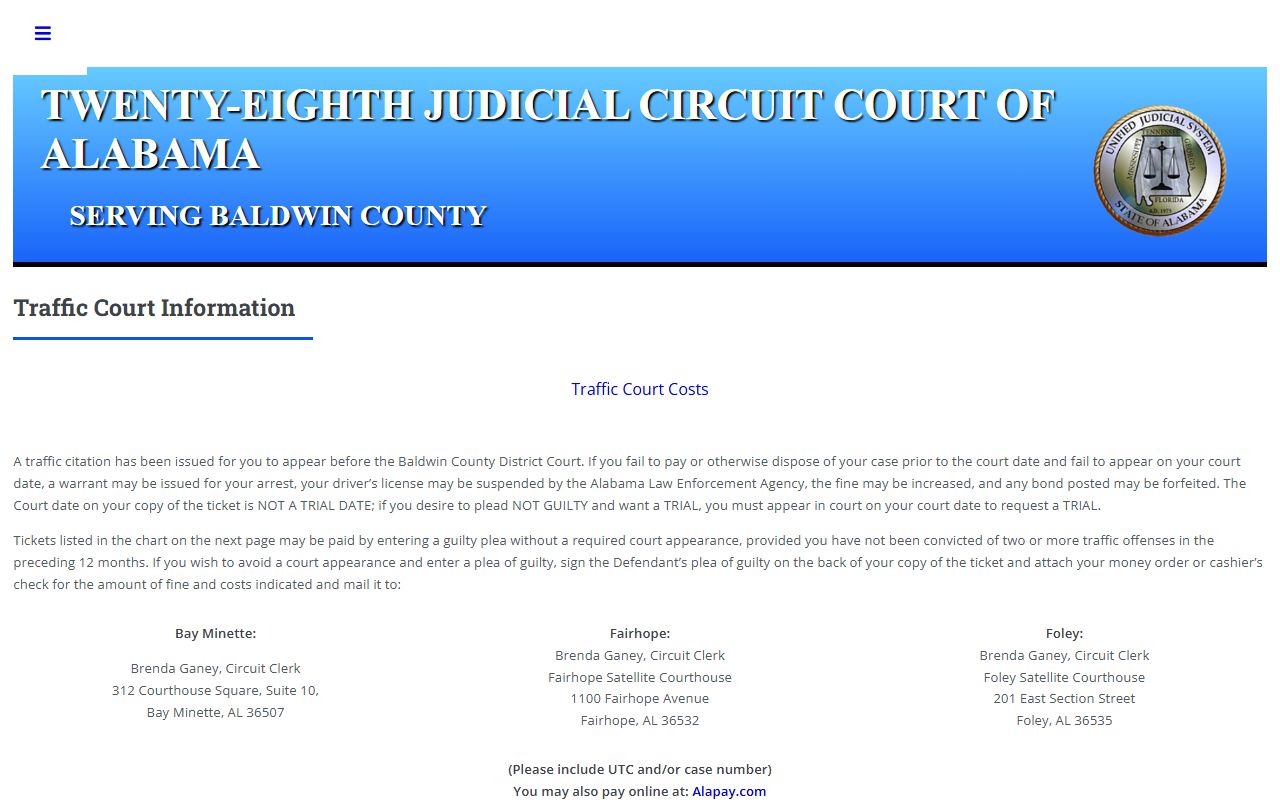
The page also links directly to Alapay for online payment and lists what happens if a case is left unresolved past the court date.
Traffic cases in Baldwin County go through the District Court docket. Citations from Alabama State Troopers and Baldwin County Sheriff's deputies both route here. The date printed on your ticket is a court date, not automatically a trial date. If you plan to plead guilty or pay the fine, you can often resolve the case on or before that date without appearing in person, using Alapay for eligible citations. If you want to plead not guilty and contest the ticket, show up on the court date and tell the clerk. The case will be set for a separate trial date.
Missing your court date carries serious consequences. The official traffic page says failure to pay or otherwise resolve the case before the court date, combined with failure to appear, can trigger an arrest warrant, a driver's license suspension by ALEA, an increased fine, and forfeiture of any bond posted. None of those outcomes are easy to undo. If you realize you missed a court date, contact the Circuit Clerk or the Alabama Traffic Service Center promptly rather than waiting for something to happen. Acting early usually produces better options than waiting for a warrant to be served. The official traffic court cost schedule lists the fines for specific violations.
Baldwin County District Civil Filing Fees
Civil filing fees in Baldwin County District Court are set by the official civil fee schedule. The fees below apply to District Court civil cases, including small claims. Domestic relations cases (divorce, child support, custody) follow a separate fee structure and are filed in Circuit Court; uncontested divorce costs $227.00. All fees are due at filing and are non-refundable.
| Case Type / Item | Fee |
|---|---|
| Small claims / District civil up to $1,500 | $82 |
| District civil $1,501 to $3,000 | $156 |
| District civil $3,001 to $6,000 | $245 |
| District civil $6,001 to $20,000 | $277 |
| Each additional defendant | $10 |
| Garnishment or execution | $30 |
| Subpoena | $12 |
| Child support filing | $134 |
If you cannot afford filing fees, you may qualify for a fee waiver by filing an Affidavit of Substantial Hardship, available through the Alabama eForms portal. The court decides whether to grant the waiver; there is no automatic exemption. After a judgment, additional costs like garnishment or execution fees apply if you need to collect what you are owed. The Circuit Clerk charges $10 for a computerized record search and $25 for paper or archived records, plus $5.00 for the first 20 copied pages and $5.00 per certification.
Court Locations and Contact Information
Baldwin County District Court operates from three locations. The main courthouse in Bay Minette handles the bulk of filings, record requests, and most dockets. The Fairhope and Foley satellites serve residents in the eastern shore and south county areas, reducing the drive to Bay Minette for routine matters. Not every hearing type is held at every location; check your notice or call the clerk before assuming your case will be at a satellite.
312 Courthouse Square, Suite 10
Bay Minette, AL 36507
Phone: (251) 937-0280
Hours: Monday-Friday, 8:00 a.m. to 4:30 p.m.
1100 Fairhope Avenue
Fairhope, AL 36532
Phone: (251) 928-3002
201 East Section Avenue
Foley, AL 36535
Phone: (251) 943-5061
Circuit Clerk Brenda Ganey oversees record maintenance for both Circuit and District Court. For online case lookup, use Alacourt ACCESS, where name searches and case-number searches each cost $9.99. Subscriber accounts at the subscriber portal offer more frequent access. For certified copies or archived/microfilmed records, use the official Circuit Clerk request form and allow two weeks for processing.
District Court vs. Circuit Court vs. Municipal Court
Alabama has three types of trial courts that Baldwin County residents are likely to encounter. Each one handles a different range of cases. Understanding which court applies to your situation saves time and prevents filing in the wrong place. Alabama does not have county courts at law (a Texas concept) or Justice of the Peace courts. The table below shows the key differences.
| District Court | Circuit Court | Municipal Court | |
|---|---|---|---|
| Civil Limit | Up to $20,000 (small claims up to $6,000) | No upper limit; handles over $20,000 and smaller concurrent cases | Generally no civil jurisdiction; ordinance fines only |
| Criminal Jurisdiction | Misdemeanors; preliminary felony hearings; non-death felony guilty pleas | Felony trials; appeals from District and Municipal courts | City ordinance violations; municipal traffic and misdemeanor offenses within city limits |
| Family Cases | Juvenile concurrent; child support | Divorce; custody; adoption appeals; termination of parental rights | No family jurisdiction |
| Appeals | Appeals go to Circuit Court (de novo trial available for misdemeanor convictions) | Appeals go to Alabama Court of Civil or Criminal Appeals | Appeals go to Circuit Court |
One practical note: if your ticket or summons came from a city police department (Bay Minette PD, Fairhope PD, Foley PD, Gulf Shores PD, and others), it may be a municipal court matter rather than a District Court matter. The Circuit Clerk's request form specifically states the office cannot supply municipal court records. Contact the city directly for municipal court information. If you are unsure which court has your case, search Alacourt ACCESS by name to see which court and case type appears.
How a Baldwin County Case Moves Through the System
Cases in Baldwin County follow different paths depending on whether they are criminal or civil. Both paths end at Circuit Court if appealed, and both use Alacourt for public records access. Knowing the flow helps you understand where your case stands and what comes next.
Criminal flow (misdemeanor): Arrest › First Appearance/Bond Hearing in District Court › Arraignment (charge and plea) › Pretrial Motions › District Court Trial (no jury) › Sentencing › Appeal to Circuit Court (de novo, jury available)
Criminal flow (felony): Arrest › First Appearance in District Court › Preliminary Hearing in District Court › Grand Jury Indictment or Information filed in Circuit Court › Circuit Court Arraignment › Pretrial Hearings › Circuit Court Trial › Sentencing › Appeal to Alabama Court of Criminal Appeals
Civil/small claims flow: Statement of Claim filed in District Court › Service on Defendant › Defendant Answer (14-day deadline) › Default or Contested Hearing › District Court Judgment › Garnishment/Execution (if needed) › Appeal to Circuit Court within 14 days of judgment
Traffic cases follow a compressed version of the civil/criminal flow: Citation Issued › Court Date on Ticket › Pay (Alapay or in person) or Appear › Plea or Trial › Judgment › Appeal if contested. Failure at any step to appear or pay can trigger a warrant, license suspension, and increased penalties. For any case where you want to check current status, the fastest route is Alacourt ACCESS by name or case number.
The Twenty-Eighth Judicial Circuit
Baldwin County is the Twenty-Eighth Judicial Circuit of Alabama, and it is a single-county circuit. That means every Circuit Court judge assigned here serves Baldwin County only, unlike multi-county circuits found in other parts of the state. The presiding Circuit Court judge is Hon. J. Clark Stankoski. The five associate circuit judges are Hon. Byron Brackin, Hon. Laurie A. Hoyt, Hon. Karol J. Kemp, Hon. Ashley Siebert, and Hon. Scott P. Taylor. All six circuit judges share the Baldwin County courthouse system and rotate through trial assignments on the 2026 court calendar, which includes jury terms, motion dockets, criminal non-jury weeks, and civil docket settings.
The Twenty-Eighth Judicial Circuit home page at baldwin.alacourt.gov covers the full range of court information for Baldwin County: judge listings, clerk information, court costs, forms, juror information, passports, and absentee election manager functions. Circuit Court has appellate jurisdiction over District Court and Municipal Court decisions, which is why a misdemeanor conviction in District Court can be re-tried de novo in Circuit Court if the defendant appeals. The same court calendar governs when cases are set; check the Circuit Clerk for specific docket dates tied to your case. For more on what records are available from this court system, see Baldwin County court dockets and the Clerk of Court page.
Note: Alabama courts operate as part of the Unified Judicial System under the Alabama Supreme Court; local rules and scheduling notices from the Circuit Clerk control specific hearing dates for your case.